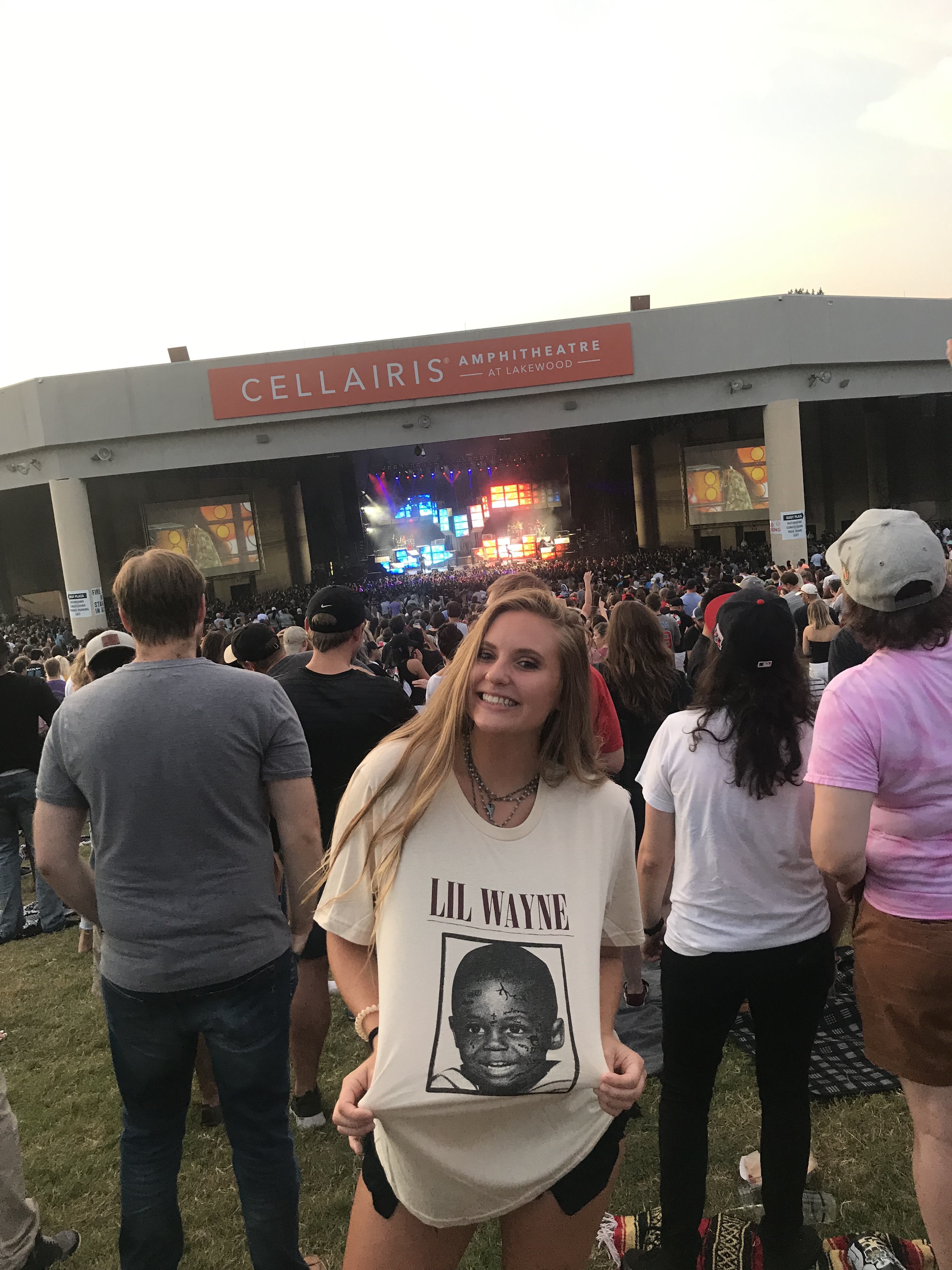
Lil Wayne and Blink-182 Live in Concert

Last night, July 27th, was the perfect night for a summer concert! My sister and I have been long-time fans of Lil Wayne, who is one of the most iconic and well-known rappers of all time. Along with Lil Wayne, my sister is a huge Blink-182 fan. So, when we discovered they were coming to Atlanta to perform at the Cellairis Amphitheatre at Lakewood, we bought tickets immediately for the 7:30 pm show. Blink-182 is a punk rock band that has been playing together since the late 90s. The venue is an outdoor concert space that is perfect for summer concerts.

There was an interesting mix of people at this concert. There were a lot of hardcore punk rock fans there for Blink-182. Tattoos, piercings, spray painted t-shirts and the faint smell of weed were everywhere. There were also a mix of festival outfits and jerseys that can be correlated to rap concert attire. However, throughout the concert, we were all enjoying the music regardless of who were there for.

The opener was a British rock band named Neck Deep. I personally have never been a huge punk rock fan, so I did not know any of their songs, but they had a great energy to them! Their band consisted of the drums, lead guitar, bass guitar and keyboard. In typical punk rock fashion, the members of Neck Deep wore skinny black or blue jeans and oversized t-shirts. Unfortunately, I showed up a little late and missed most of their set, but the songs I did hear put a lot of emphasis on the guitar.

Since Lil Wayne and Blink-182 are co-headlining the tour, they take turns on who opens and closes the show. For this show, Lil Wayne was chosen to take the stage first. Let me tell you as a Lil Wayne fan since I was in the sixth grade, the moment he took the stage I lost it! As a rapper he doesn’t really have a band, but has two DJs that play with him as he raps. His energy was everything I had hoped it would be! Weezy, as many call him, was dancing around the stage and interacting with the crowd as lights, smoke and pyrotechnics were going crazy around him. He played many of his older popular songs like “HYFR,” “No Worries,” and “The Motto.” Many of the songs he sang were collaborations with other artists like Drake, Chance the Rapper and Travis Scott so Lil Wayne would just rap his part and the chorus of those songs. Carter V was a long awaited album from Lil Wayne that was released (FINALLY) in September of 2018. He played songs off of this album like “Let It Fly” with Travis Scott, “Mona Lisa” with Kendrick Lamar, and “Uproar” with Swizz Beatz. Although I enjoyed every single one of these songs, one song and performance really stood out. Lil Wayne told the audience “If you have anyone looking down from above right now, I want you to point and say this one is for you,” and began to sing another Carter V song “Don’t Cry” with the late XXX Tentacion. The song says “bury me in New Orleans, tombstone reads don’t cry, stay tuned// if heaven is as good as advertised I want a triple extension on my afterlife Rest in Paradise.” Although he is a rapper, he is a very religious person and gospel references are used throughout his albums and mixtapes.

The reason I have been such a huge Lil Wayne fan and probably will always be is because of his lyrics. He is so creative in the way he says what he wants to say. In his song “Can’t Be Broken,” which he performed as well, the lyric goes “they do all they can do but you can’t break unbreakable” which is a song I listen to whenever I am overwhelmed and feel like I cannot do it. Along with his lyrics, his music is not like all the rap you would expect. There are definitely those hard-hitting and beat dropped songs like “Rich As Fuck” and “Love Me,” but a lot of his songs use smooth sounds that can connect to blues and jazz. I think this comes from his New Orleans roots. His songs “Famous” and “Demon” are excellent examples of this musicality. Honestly, this concert just solidified my belief that Lil Wayne is the greatest rappers of all time. If you disagree, I encourage you listen to some of the songs I mentioned!

Blink-182 was a band I had never heard of before the concert, but I left the concert a fan of them! They sang about relatable topics like growing up, first dates, and break-ups. There are three main members of the band that play drums, guitar and bass guitar. The two guitar players both sang an even amount. Blink-182 does a great job of harmonizing and keeping a simple form but playing it in an exciting way. They all wore the typical skinny jeans and graphic tees of other punk rock bands like The Cure and 1975. Their energy was unlike anything I had ever seen before. Dancing and jumping around while playing their instruments and even the drummer had a 3-minute solo where the entire platform turned upside down with him playing. It was wild. Their sound is definitely defined by the hardcore guitar playing and drum solos, which I loved. “Dammit” and “All The Small Things” are great examples of the emphasis they put on the guitar and drums. The majority of their songs played were upbeat and had an upward contour throughout. “I Miss You” and “Down” are songs that they played acoustic and a little slower than the versions they have on Spotify. They even entered the crowd with their guitars to play these songs, which was so cool.

The crowd was absolutely loving the performances of both entertainers, but it was electric during Blink-182’s set. Everyone was singing along and throwing up the rock and roll hand signal. It inspired me to go home and listen to them, and I have found that I really like their music! I am including two music videos they have from when they first began. One thing I love about them is that they bring the same amount of energy to their performance as they did for the videos, even years after the fact.

Overall, this was one of the best concert experiences of my entire life. Not only did I get to witness one of my most favorite artists of all time, but I was also introduced to a band and genre of music that I never thought I would like before. I think the important thing about music is to keep an open mind and not to limit yourself to one particular genre. Music has the power to unite us and inspire us, and I definitely felt that power last night.
Musical Web

The song “Maple Leaf Rag” by Scott Joplin was a very interesting piece to start this course with. It was easy to focus on the piano playing and the unique chords he chose to use. This song is played in an upward contour with a fun energy about it. The quick and sharp piano playing makes this song upbeat and easy to dance to. The African American community at the time this song was written was definitely into ragtime and jazz. The song also mentions some of the hardships he and other people he knew went through, while also saying that he could let it all go and “hypnotize the nation” with the Maple Leaf Rag. The lyrics tell a story of him being a poor man in Virginia (“I have no wealth to speak of ‘cept the clothes upon my back”) , but he danced (“I can do the country hoe-down… step back and watch my motion”), which gained the attention of other people in his community. This includes ladies (“The men were struck with jealousy… ladies gathered round me”). The chorus repeats three times after three verses. 

After the completion of the course, I am able to see the incredible influence this song and artist had on the jazz musicians who came after him. The fact that this song was used often to teach others to play the piano is amazing. Although this song is considered ragtime, it connects and “streams” into other forms of music like jazz and bebop. The upbeat and rhythmic style of this song connects well to swing music, which was a style that became popular in the 1930s and 40s.

“Walk This Way” by Aerosmith- I found this piece interesting because I have always considered it just a rock song, until I listen to the RUN DMC version and realized the verses have a hip hop vibe to them. The guitar is the most important instrument in this song from start to finish. It is interesting that the guitar chords in the beginning of the song are meant to represent a kiss following “Like this” throughout the song. Aerosmith’s lyrics for this song are very sexual, and this song is a great example of the sexuality of their songs and the Rock era as a whole. The lyrics and music work together to tell a story of an high school aged boy trying to get girls, which reflects a lot of fans of rock during the 70s and 80s. Teenagers were some of the biggest rock fans. The way the lyrics describe the girl/situations in which the guy was around the girl make it easier to imagine. The chorus is “Walk this way/Talk this way” and repeats the verse about “seesaw swingin’… I knew that love was here to stay when she told me to” twice before the chorus. 

I absolutely love this song because of the upbeat electric guitar and the rap-like element of the verses. After listening to the song many, many times, I noticed a little bit of call and response in the verses. The Run-DMC version definitely highlights this when they emphasize the last word in each phrase. I like the fast verses followed by the louder singing of “Walk this wayyyy!!” in the chorus. I also noticed that the guitar plays specific chords after the phrase “like this” in the song in order to represent a kiss.

Hair metal in the 80s all have this similar hard rock and sexual vibe about them. I connect this song with “Pour Some Sugar on Me” by Def Leppard for that very reason. The guitar and drums in these rock songs are key identifiers in connecting the songs of the 80s. The upbeat melody makes it nearly impossible not to bob your head to. “Walk This Way” could be an example of rock music streaming into rap, which gained a lot of popularity in the 90s. As rock bands began to use fast paced verses and phrases, I think that many rappers that came after them were inspired by this style of music.

This is one of my favorite performance of this song.

“That’s All Right” by Elvis Presley- I have personally loved this song for years, and it is obviously interesting because it laid the foundation for the shift into rock we know and love. Before taking this class, I don’t think I ever noticed the mix of blues and country styles in this song or in rock as a genre. However, after listening to this song in a more objective way than I use to before. There is a clear underlying blues rhythm and style, but Elvis’s voice and guitar playing bring an added element of twang and country style to the song. Presley also drags out his vocals in a way that makes it sound bluesy. This song has an upward contour and tells a (short) story of a man who loves a girl his family doesn’t approve of. I think the music and lyrics both give a carefree and light attitude toward this situation. Kind of like, “That’s all right, I’ll just leave town. No big deal.” vibe to it. “That’s all right, mama” is repeated throughout the song.

If you cannot tell, I really like rock music. Elvis Presley remains one of the most influential artists in history. Whether it is rock, alternative or country music, there is probably influences of Elvis in there. This song in particular can stream into country music when considering the musicality of the song. The way he sings and the subject matter of the song connects it to the blues songs we listened to in this course.

“Get Off the Track” by the Hutchinson Family- I found this song interesting for a few reasons. One, the tune kind of reminded me of “Yankee Doodle” for some reason. Two, the style of piano playing that made it sound like another instrument like a banjo. Three, the metaphors throughout the song such as emancipation as a “majestic” train car “rolling through their nation” that they are tell people to “get on.” Slavery is the track they are mentioning. They are being pretty straightforward in telling their audience to “get off the track” of slavery to support emancipation. It even goes as far to say “clear the track or you’ll fall under.” This means you might as well join us because freedom is coming whether you move or not. As a white band performing for white people, I believe the song served its purpose because they wanted to write something that could convince or sway others to join the abolitionist movement. I am sure not everyone liked this song at the time, but it was an important piece for that time. 

This is one of the early examples of protest music. The way the song rhymes throughout kind of reminds me of nursery rhymes and children’s songs, even though it is talking about a serious topic. The piano playing and style of music has a very upbeat and innocent sound almost. This song intersects with other examples of protest music and our unit on folk music that we discussed in this course. However, I cannot pinpoint any modern music that may stream into this song.

“Brighten the Corner Where You Are” by Homer Rodeheaver- I found this piece interesting because I loved the message the song is telling. It is saying do not wait for the world to change or for someone to make it better. You have the talents and abilities to “brighten the corner” or make the world a better place from where you are. I like this because if everyone brightened their corner, eventually the whole world would be brighter. I believe the organ is the instrument used in the recording I listened to, which gives it a church. The community this song was written for is one of Christians. This song was well written for Christians because the gospel tells us “to go forth and spread the word,” which could be related to brightening your corner. I hear some call and response between the phrases. The chorus is repeated (as well as the simple tune) throughout the song… “Brighten the corner, where you are.” 

This song definitely streams into modern gospel music and this may be an odd connection, but it reminds me of music that can be seen in musicals and plays because of its storytelling. The melody reminds me of a lot of traditional hymns like “Amazing Grace” that we listened to in the course.

Although these songs are completely different genres and styles, they all connect through their storytelling ability. They all make the person listening to it feel the desired feeling. Whether they want you to support a cause, inspire goodwill, or just dance around, these songs all made me feel what they wanted me to.

Music for Change

Music has always been a medium in which people express themselves. Their feelings, experiences, beliefs and their hopes for the future. Throughout history, artists have written songs that promote change and protest against the negative things in the world. Many slaves sang spiritual hymns and songs about their struggle that were later used as inspiration for songs during the Civil Rights Movement in the 1960s. During the Vietnam War, popular folk singers like Judy Collins and Tom Paxton wrote songs that protested the violence of the war and promoted peace between all. Even today, artists like the Black Eyed Peas and Childish Gambino are using their gifts to protest racial discrimination, police brutality and environmental destruction.

The protest element in modern music is not always obvious. Most of the time, it is in the subtle phrases within the verses. An excellent example of this is John Mayer’s “Waiting On the World to Change.” He wrote it from the perspective of young people who recognize that the world is messed up and needs to change, but they do not know how to make this change happen. As a young person myself, I know all too well that many adults believe that my generation doesn’t know what we are talking about or what we are standing for. This can be discouraging, which Mayer’s song mentions. It can get to the point where you are just waiting for it to change. This song is a subtle plea for people to stop waiting and take action in the world. There is a quote by Ghandi that says “Be the change you want to see in the world.” John Mayer’s song is telling us it is time to stop waiting.

Other songs of protest are blatantly obvious in their protest. One great and hilarious example is “Earth” by Lil Dicky. Lil Dicky is a comedic rapper who is known for making songs and raps that are so funny and random that you cannot help but enjoy them. This past Earth Day, he released a song accompanied by a music video in order to raise awareness of pollution, littering and global warming. He recruited COUNTLESS other artists and celebrities to sing this song and have a part in the video. Artists like Justin Bieber, Ariana Grande, Shawn Mendes, Snoop Dog, Katy Perry, Miley Cyrus, Ed Sheeran, Leonardo DiCaprio and about twenty other artists that support green initiatives took part in making the song. In wake of Donald Trump and other officials’ comments on the validity of climate change, Lil Dicky thought it was important to showcase all of the creatures that are in danger because of human impact. This song and video are a fun and catchy way to show people the planet we all need to work to protect.

Regardless of how artists choose to format and express their protests, music will always be an important tool to inspire change and raise awareness of important issues.

“Gumbo” Film Review

Jazz is seemingly one of the most diverse and exciting musical genres in the world of music. I make this statement confidently after learning more about the background of jazz. From sacred spiritual hymns to Louis Armstrong to the musicians of today, jazz and the blues have transcended the test of time by continuing to adapt while staying true to its foundation. In the film “Gumbo,” jazz musicians describe jazz as “a selfless collaboration” and as a way to creatively pioneer and explore music and themselves. Early jazz came almost entirely on the spot as groups of musicians would come together and really just vibe. It wasn’t until later that people realized that the music could be written down and inspire a whole world of people.

New Orleans is one of my favorite places I have ever been. You can still feel the incredible musical influences. Although “jazz was born in New Orleans,” slavery is also a large part of its past. New Orleans played a big role in the slave trade in the way that thousands of slaves were introduced to America and the new way of life there. It is said in the video that to survive, the slaves had to improvise. This improvisation coupled with their powerful hymns gave birth to the wonderful genre of jazz. Congo Square was a place where slaves were allowed to sing and dance, where they even attracted white crowds. These songs and dances were heavily influenced by the percussion and rhythmic styles of the Caribbean.

Creoles were the children of Spanish and French settlers of New Orleans and black slave women. These people usually identified with their European descent and were classically trained in music. It was them that began to play their music for a living when racial culture changed in New Orleans. Around the time of Jim Crow laws, black people used the blues as a way to work through and almost escape what they were going through. The blues were diverse in their stories. Singing the blues was a way to deal with the blues they had. It was about emotion and overcoming their experiences.

Even though the time period depicted in the film is one of our nation’s darkest and most disappointing times, the music that resulted from that time have been the foundation for a lot of the music that is made today. There is a mixture of culture in New Orleans that created the best environment for creativity and music to thrive, despite the political and racial tensions. The blues and jazz represented freedom and the early days of black power.

Source:

Gumbo: Ken Burns’ Jazz, Part 1. Directed by Ken Burns. Public Broadcasting Service, 2000.

Soundtrack for a Revolution- Film Review

The Civil Rights Movement is one of the most pivotal moments in the United States’ history. It was the moment when African American people, along with some supportive whites, decided that segregation was immoral and it was time to make a change. These people were usually met with hate and violence from the police, and many were arrested in the process. However, one thing they felt could never be taken from them, was their songs.

This film depicts many Civil Rights leaders including John Lewis and Martin Luther King, Jr. It also includes recounts from sit-in protestors and bus boycotters who tell stories of their experiences during the Civil Rights movement. John Lewis says in the film, “It was the music that created a sense of solidarity.” In the times of great unrest, the African American people were able to turn to their music as way source of strength to continue in their fight. One of the reverends in the film talks about how “negroes have always used music as a way of communication” even as far back as slavery, which we learned about those songs in one of our modules. “Wade in the Water” by Ramsey Lewis is sang multiple times in this documentary. It tells them that even if the waters are troubled, wade in what is right not what is easy. The song has quick piano playing, trumpets and drums. It is a song that is natural to clap along to and easy for large groups to sing, making it a wonderful protest song.

Alabama and Mississippi were important states during the Civil Rights movement. Montgomery, Alabama was where the bus boycotts and sit-ins began that inspired people in other cities to do the same. The Freedom Riders rode from Alabama to Mississippi in order to prove that whites and blacks could be together in harmony. They were met with violence and many of them were arrested. However, people continued to join them anyway. During this part of the film Joss White sang the song “Paul and Silas Bound in Jail.” This song is a blues song originally written by Josh White that is basically an anthem for holding on and remembering the main goal/prize. The cello, piano, guitar and soft drums join a powerful bluesy voice to create a powerful performance.

According to Chuck Neblett, many of the songs they sang during this time were negro spirituals that they revisited. They were powerful and spiritual songs of protest. They gave the people a sense of comfort. They would also create their own lyrics based on what was going on. For example, the song about Governor Wallace of Alabama that is sang by Lynda Lowery that talks about needing to remove him. The theme song of the movement was “We Shall Overcome,” which came from an old black hymn with a simple three chord structure. I think this is a great example of how music culture changed. This song was written as a church hymn that was probably about individual overcoming obstacles. When the world began to change, the impact of the song changed and it became an anthem for an entire race of people to overcome.

Birmingham was one of the most violent and vital city in the south during the Civil Rights movement. Leaders believed it was important to go there to fight their evil with peace. It was here when they struggled to find participants. However, it was school kids that were glad and passionate about the protests that revitalized it and led to Birmingham outlawing segregation. This led to the incredible force that was the March on Washington to change the nation. It was there where Martin Luther King, Jr. delivered his legendary “I Have a Dream” speech.

It was the music that kept them going during that long 50 mile march from Montgomery to Selma, Alabama. They sang and sang the whole way there which gave them strength. I personally believe that the Civil Rights Movement would not have been what it was without the music. The music was necessary to comfort and inspire the people to keep going when it was difficult, and it was mostly difficult.

Source (film):

Soundtrack for a Revolution: Freedom Songs from the Civil Rights era. Directed by Bill Guttentag and Dan Sturman. Freedom Song Productions, 2009.

How Great Thou Art

For this post, I would like to give another example of a traditional hymn that has been covered countless times. Like “Amazing Grace,” the song “How Great Thou Art” has been a favorite amongst Christians and music artists alike. “How Great Thou Art” was originally written by Carl Boberg in 1885, who was a preacher in Sweden. The song was originally written as a poem. However, the version we know and love today is thanks to a British minister named Stuart K. Hine. The entire song is written in awe of God’s power and in appreciation of all things He placed on this Earth for us. The song mentions things like stars, mountains, forests birds and even the breeze. Not only is this a classic hymn to hear on Sunday morning in church, it has also been covered many times by big name artists like Carrie Underwood, Elvis Presley, and Jennifer Hudson with the Pentatonix. The song has also been sang in singing competitions such as The Voice.

I would first like to talk about my favorite version, Carrie Underwood’s featuring fellow country artist Vince Gill. At the 2011 American Country Music award show, Carrie delivered an extremely powerful and moving performance of “How Great Thou Art” that left an audience of performers rising to their feet and some even moved to tears. The performance began with her softly singing accompanied by soft piano playing. As the song continues, they are joined by Vince Gill’s guitar playing and harmonizing with her on the chorus. During the “how great thou art” part, Carrie Underwood shows off her extremely powerful voice. The first chorus is followed by a beautiful guitar solo by Gill. The rest of the song becomes increasingly powerful as more of the band joins in and Carrie’s voice continues to get louder with big notes.

Like Carrie Underwood, Elvis begins his performance with a soft and reverent voice and piano playing. Unlike Carrie, Elvis is accompanied by a group of singers who begin singing at 1:14. At about 1:33, Elvis continues to sing. The performance goes from reverent to a little more “Elvis” style at 1:50 when Elvis gets louder and the band joins in. The piano playing changes style as well as his voice into that iconic style of singing he is known for. The rst of the group of singers join in for an upbeat and exciting performance for the rest of the song.

The Pentatonix are a very popular acapella singing group. This means they use their voices and other body parts in order to make music. This performance with Jennifer Hudson begins with her singing alone without any other sounds accompanying her. She is joined by other singers one by one, however, they are not making any musical sounds until 1:24 when they begin stomping and clapping along with the beat. It is interesting to hear the song without a piano playing.

Sources:

https://www.thetabernaclechoir.org/articles/how-great-thou-art.html

Amazing Grace- Film Review

The beginning of the film immediately caught my attention when it mentioned the power words have in a song. Yes, the tune is what gets stuck in your head. But the words? That is what truly gets stuck in your heart and stays with you. The film said it best when it said that the words are what makes the connection with people. Music is a universal trait in every culture in the world, even though it is different everywhere in the world. The lyrics to these songs reflect the culture of the people who listen to them. Therefore, the lyrics connect people to culture itself.

The song “Amazing Grace” has been covered countless times by countless artists in its long history. Judy Collins explains its popularity as refresher of people’s inner memories. I can relate to this because I do not remember ever learning the song, I cannot remember not knowing it. Judy Collins sang it in the 1970s as a powerful ballad in concerts and on the radio, while Jean Ritchie performed it has a folk song with her family. The differences in these versions show the versatility of the song. I think the song survives the different stylings because of the emotional connection people have with it. In Viper, Kentucky, there is a family that reunites once a year, and they have a tradition of singing “Amazing Grace.” All over the country and world, there are these stories of inner memories connected to the song.

In The Parish of Orley in England, they still sing “Amazing Grace” with their own memories attached to it. John Newton, the composer of “Amazing Grace,” was an English clergyman in the late 1700s who is being depicted in the film. He wrote this song as part of his weekly duties for the church. The song tells of his difficult life as a slave trader and God’s grace saving him, even if he was a “wretch.” In addition to being sung in churches, family reunions, and on radio stations, “Amazing Grace” has also been covered in Opera houses throughout the world.

Everyone has a past and the past is not always pretty. We have all had times of darkness or “wretchedness” that we feel we cannot possibly be saved from. Judy Collins talks about her personal dark times and how “Amazing Grace” served as her beacon of hope. It serves this purpose for many other people as well. It was even sung at the end of an hours-long rock concert for Nelson Mandela’s birthday.

The original composition of the song called for it to be sang in a simple and straight form. However, when it gained popularity in the 1960s, it took on a more lyrical form. In Folly Springs, Georgia, there is a church that sings the song with so much passion and emotion for the song. They sing it in a shape-note form. In Ozark, Alabama, the song was sang at a 91st birthday party. The Black Sacred Hearts also sing it in shape-note. The way you sing the song can change the entire feel of the song, but the emotion and meaning remain the same.

My personal favorite is Johnny Cash’s version, which I had heard long before watching this film. I was very happy to see him in the film. Johnny Cash went through so much in his life from the death of his brother to his addiction to drugs and alcohol. This song represented his journey to redemption. He sang “Amazing Grace” in is first prison concert at Huntsville in Texas in 1957. The prisoners there also had deep connections to the songs, some to the point of tears. These hardened men who did unspeakable things, found the true meaning of grace and peace. This song reminds them of that.

Music culture is ever-changing and will be until the end of time. As generations change, so does their chosen way to express themselves. Now, rap and pop and country music have become extremely commercialized, which represents our current culture. However, we still have those connections to the older and more reverent songs like “Amazing Grace.”

Source:

Amazing Grace: The Story of a Song That Makes a Difference. Directed by Elena Mannes, Performance by Johnny Cash, Judy Collins, Jessye Norman, Jean Ritchie, Marion Williams. Corporation of Public Broadcasting, 2003.

Robert Johnson’s Story

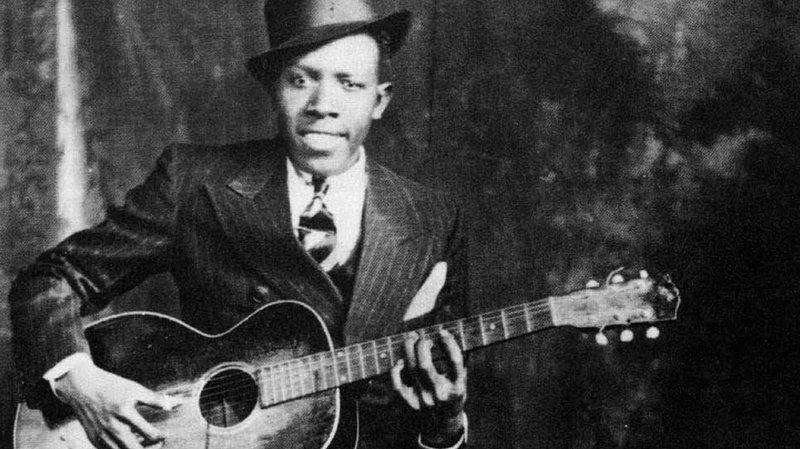
Robert Johnson is known as one of the greatest Delta Blues musicians, although many people did not recognize this until after his death. Johnson was born in May 1911 in Mississippi. Delta Blues was one of the most popular musical style in this area at the time. There is not much known about his life, so some have created theories on his life and rise to success. One widespread opinion is that he sold his soul to the devil in order to become such a blues success. However, most of his success was achieved posthumously. During his lifetime, he performed mostly on street corners and small clubs or dances. He was believed to have written twenty-nine songs between 1936 and 1937, which include blues classics like “Sweet Home Chicago” and “I Believe I’ll Dust My Broom.” In addition to his mysterious life, he untimely died at the age of 27 from an alleged murder by poison. The songs he wrote in the last three years of his life have become a standard for blues and jazz music today.

Robert Johnson’s most listened to song on Spotify is “Cross Road Blues,” so it naturally peaked my interest. I was expecting the typical jazzy/blues sound with all the typical instruments. However, what I heard was just incredible steel guitar playing accompanied by the raspy voice of Robert Johnson. The crossroad is a metaphor for making a decision or choosing a path to take in life. He mentions falling down on his knees, symbolizing that he has a difficult choice to make. The line “Didn’t nobody seem to know me, babe, everybody pass me by,” makes it seem as though he has to make it alone. The melody seems to follow a wave-like contour. The quick plucks of the guitar strings blended with the deeper bass chords exemplify the mix between country and blues that Delta Blues is.

The second song I would like to discuss is one of his most classic songs, “Sweet Home Chicago.” His voice in this piece ranges from the high pitched “Oh, honey don’t you wanna go?” to the lower pitched “To my sweet home Chicago.” The quick strums of the guitar during the verses make the song easy to dance along to. The way he sings the verses is more like talking, while the chorus shows his singing voice and range. You can hear the bluesy whine in his voice that is often associated with the genre.

Sources

https://en.wikipedia.org/wiki/Robert_Johnson

https://www.biography.com/musician/robert-johnson

Ma Rainey’s Story

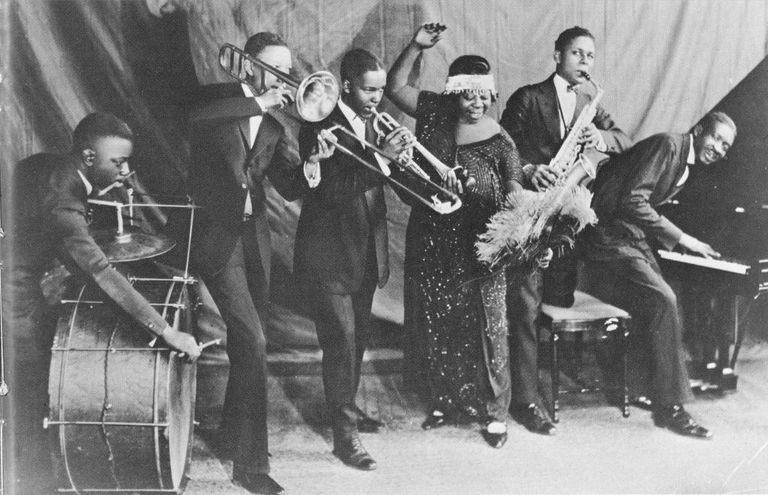
Ma Rainey was an extremely popular and influential Classic City blues singer in the early 1900s. She is known to be part of the first generation of singers to use authentic blues style in her songs, earning her the title of “Mother of the Blues.” Ma Rainey was born in Columbus, Georgia by the name of Gertrude Pridgett in April 1896. Ma Rainey, considered the first female blues singer, spent three decades performing the blues with her peak popularity in the blues era of the 1920s. Since there was not much blues influence in Columbus, her family’s Christian roots had a great deal of influence in her early music. It was not until she had traveled around the rural south that she was introduced to authentic blues, which she incorporated into her repertoire. She also spent a great deal of her career performing in Chicago and New Orleans.

Ma Rainey was often praised for her ability to capture the essence of blacks in the south, which gained her a great following. She recorded her first album in 1923 that included the classics “Bo-Weevil Blues” and “Moonshine Blues.” Her songs about love and sexuality coined her the nickname “Madame Rainey.” They told stories of heartbreak, promiscuity, the workplace, superstition and drinking, which were considered to reflect southern African-Americans life during this time. She died in 1939 in Rome, Georgia.

The first song I would like to talk about is “Daddy, Goodbye Blues,” which was released in 1928. First, I would like to talk about the text of this song. The song tells a story of her man leaving her, so he is actually the “daddy” she is referring to throughout the song. The verses have an A-B-C-B structure throughout, with each verse ending in the repeated phrase “Goodbye Goodbye/Daddy, Goodbye.” You can hear the sadness in her low vocals, contributing to the blues and jazzy feel of the song. The song begins with a harmonica and classic blues piano style playing. There seems to be an element of call and response happening between the two instruments that continues throughout the piece. If you pay close attention, you will notice the tempo of the piano playing switch from slow to quick throughout the song.

The second song I would like to discuss is “Cell Bound Blues,” recorded in 1924. Thinking back to the era in which this song was written, women did not have many rights or protections. African American women had even less of both. This song is about a woman who shoots and kills her abusive husband, as a result of him hitting her. In the song when she asks “Hey, hey, jailer, tell me what have I done,” I think this is a mixture of guilt and disbelief of what she had done. This is a common feeling for women in that situation. The musical style of this song exemplifies the blues in New Orleans. The use of the harmonica, saxophone, piano, and trumpet I believe contributed to this wonderful blues feel. Notice the part of the song where the lyrics say, “I walked in my room, the other night.” This is the part of the song where she explains what happened. The rhythm of the song changes slightly here for a dramatic effect. The trumpet plays a quick four notes then stops after each phrase.

Sources

https://www.biography.com/musician/ma-rainey

https://en.wikipedia.org/wiki/Ma_Rainey

Growing Up Rock and Roll with a Little Twang

Hello, back again! Family is our first introduction to many things in the world from religion to food to music. My parents both grew up in the era of rock and roll, and my dad was especially a huge fan. I remember listening to him play the guitar and sing songs all through my childhood. The first song I ever learned was “Born To Be Wild” by Steppenwolf. No “Wheels On the Bus” for me. I think he made it a point to teach me rock and roll songs because of the memories he made when he would listen to those songs. My sister was never a fan of his “old songs,” so my dad and I always bonded over our mutual appreciation for it.

My mom grew up in a small town in Georgia, the same one I was also raised in. Although she enjoyed the music of the 80s, her style was more the Eagles than it was KISS. In our community, country music is a big deal. Whether you’re in a restaurant or a store, it is usually country music playing. There are even monthly concerts in the park and restaurants with live music that showcase local country artists. For my mom, I think her geography and the culture within that town played a big role in molding her musical taste. Her car radio has always been set to the country station, and it probably always will be. In fact, it wasn’t until I got my first iPod that I even heard my first rap song.

My friends have definitely introduced me to so many different genres of music growing up, but my family laid the foundation for a lot of the music I enjoy today. I still love finding an 80s Rock and Roll playlist on Spotify and jamming out. I also have a few 2000s Country playlists in rotation for road trips or beach days. No matter what new music comes out, I will always have a place in my heart (and my ears) for the music I was raised on, thanks to my family!